

In July 2026, the EU’s Joint Research Centre (JRC) published a study on the quantities of packaging placed on the market between 2011 and 2025. Its headline alone attracted considerable attention. It made two key statements. First: quantities stay significant. And second: plastic was the only packaging material to grow – by 11 %. We carried out a fact check and arrived at a somewhat more nuanced view and overall assessment of the figures, which we present here.
The JRC published the study on 6 July 2026 under the title “Packaging materials in the EU: quantities stay significant, plastic grew by 11 %”.
Key facts about the study
- The report does not cover the entire European packaging market.
- It models packaging for food/beverages, pet food, household, beauty and personal care products in 19 EU Member States, which, however, account for 97 % of the EU population.
- According to the JRC, it covers around 75 % of the European consumer packaging market (fresh food, for example, is not included).
- Secondary and tertiary packaging are not included (neither secondary packaging such as folding cartons nor transport packaging such as corrugated boxes).
The fact check in brief
JRC statement 1: Packaging materials in the EU: quantities stay significant
Our comment:
While real EU GDP rose by around 21 % between 2011 and 2025, packaging volumes fell by around 4 % by weight over the same period, according to the JRC. The COVID-19 shock plays a major role here. Overall, everything points to an increasing decoupling of economic growth and packaging mass over time. We do not intend to assess whether the remaining quantities stay significant, as the JRC puts it. The decline in total packaging tonnage since 2011 is primarily attributable to glass and metal.
JRC statement 2: Plastic grew by 11 %. Between 2011 and 2025, plastic was the only packaging category on the rise.
Our comment:
First of all, it should be borne in mind that glass still accounted for around 75 % of packaging mass in tonnes in 2025 and is therefore a decisive factor in how the development of total volume by weight should be interpreted.
The impact of COVID-19 (with 2020 as THE crisis year), which produced winners and losers in terms of volume development, is not surprising. What is striking is that glass and metal are the clear COVID-19 losers and subsequently failed to return to pre-pandemic volumes.
In addition to plastics, the long-term winners also include beverage cartons and composite materials (the latter, however, from a very small base). So there are other winners besides plastics. Taking into account market share and consistency of development, however, plastic ranks first in terms of growth among the materials considered.
A closer look at the details
JRC statement 1: Packaging materials in the EU: quantities stay significant
Because we wanted to know more precisely, we first looked at the development of packaging volumes and then compared it with the development of real GDP over the same period.
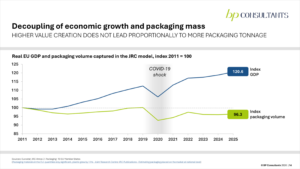 What can be clearly seen: total packaging responds in the short term to sharp slumps in demand, such as the clearly visible COVID-19 shock in 2020. In the long term, however, economic output rises faster than packaging volume. Higher value creation therefore does not lead proportionally to more packaging tonnage. Services, lightweighting, pack optimisation and material substitution evidently limit the mass.
JRC statement 2: Plastic grew by 11 %. Between 2011 and 2025, plastic was the only packaging category on the rise.
First, we looked at the current distribution of packaging volumes by weight
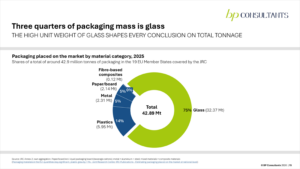
The very high share of glass, at around 75 %, is an important factor that needs to be interpreted: here, as throughout the report, packaging volume is presented in tonnes, not as the number of packages. Due to its high weight, glass automatically dominates any tonnage-based view.
We then took a deeper look at the individual packaging categories and examined how their volumes developed over the 15 years.
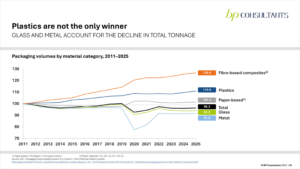
As already mentioned, the impact of COVID-19 (with 2020 as THE crisis year), which produced winners and losers in terms of volume development, is not surprising. It is striking that glass and metal are the clear COVID-19 losers and subsequently failed to return to pre-pandemic volumes.
As also mentioned, in addition to plastics, beverage cartons and composite materials are also among the “winners” (the latter, however, from a very small base). Taking into account market share and consistency of development, however, plastic ranks first in terms of growth among the materials considered.
- Plastic – structural winner: +10.9 % since 2011 and no slump even in 2020. However, growth has slowed significantly since 2020
- Mixed materials (composite materials such as …) – strongest relative growth, small base: +27 % since 2011. Because of the low absolute tonnage, the high percentage must not be confused with market size.
- Paper/board – (beverage cartons are essentially included here) largely stable: +1.3 % since 2011; significant COVID-19 boost in 2020
- Glass – long-term loser: -6.1 % since 2011; decline particularly in 2020. Due to its high density, glass has a strong influence on total tonnage.
- Metal – COVID-19 loser with partial recovery: -19.5 %5 % in 2020, +18.1 % from the low point by 2025; nevertheless, in 2025 still around 5 % below 2019 and 8 % below 2011.
