The news that plastics recycling is still falling short in many areas is not news – it is a commonplace. Newer and less widely recognised is the insight that there is real movement in plastics recycling – and in the right direction. We present four examples: the recycling of flexible packaging and HDPE packaging, the use of polystyrene recyclate, and an M&A move securing access to the resources of a leading European recycler.
Recycling is increasingly moving into the focus of policymakers, industry and society. Recent developments show that, despite all the challenges, things are slowly but noticeably starting to move in several sectors of the economy.
Example 1:
Study on advanced recycling technologies for flexible packaging
Potential, but still many limitations – in a nutshell, that could be the headline of a study conducted by the CEFLEX initiative (Circular Economy for Flexible Packaging) together with Ghent University. It assessed a range of advanced recycling technologies.
The focus was on five approaches:
- Delamination,
- Deinking,
- Dissolution,
- Contaminant removal and
- Advanced Wet Friction Washing.
The results
The results show that many processes have been technically proven and some are already in commercial use. In delamination (the separation of multilayer packaging such as PE/Alu laminates), for example, there is a 32,000-tonne plant in Germany. The “Cadel Deinking®” process removes up to 95 per cent of printing inks. “Advanced Wet Friction Washing” removes surface contaminants and achieves a recyclate yield of more than 70 per cent. And dissolution – like contaminant extraction (e.g. using supercritical CO₂) – delivers virtually pure material, a key prerequisite for the highest-quality applications.
The challenge
Most of these technologies exist only at pilot or niche scale so far. Large-scale plants are lacking, material complexity makes processing difficult, and investment cycles lag behind regulatory requirements. This jeopardises the targets of the EU Packaging and Packaging Waste Regulation (PPWR), which sets out and mandates high recycling rates and recycled-content quotas by 2030.
CEFLEX emphasises that new processes are valuable accelerators for the material recycling of flexible packaging, but do not replace the fundamentals such as optimised packaging design and mechanical or chemical recycling. Only through the interplay of technology, market, legislation and design optimisation can high-quality recyclates be produced at scale and the loop be closed.
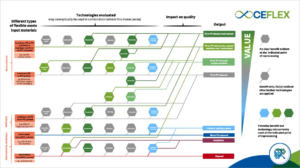
From the perspective of BP Consultants, the study and the chart shown here are further evidence that recycling is still falling short in many areas. At the same time, however, increasingly well-founded analyses are at least making these gaps ever more apparent.
Example 2:
Schwarz Group establishes full-circle recycling of HDPE packaging
According to the Schwarz Group’s 2024 Sustainability Report, its environmental division PreZero is consistently driving forward the closed material loop for high-density polyethylene (HDPE). Thanks to state-of-the-art recycling technology, PreZero has succeeded in establishing a complete loop for post-consumer HDPE bottles.
Collection: The starting point is private households, where the bottles are collected via the Yellow Bag or Yellow Bin (Germany’s separate collection system for lightweight packaging). The material is then sorted by polymer type in highly specialised PreZero sorting plants for lightweight packaging. To increase transport efficiency, the HDPE packaging is baled and shipped to the recycling plant in Grünstadt (Rhineland-Palatinate).
Processing: This is where the actual reprocessing begins: the bottles are first sorted by colour, then shredded and thoroughly washed, and the resulting plastic flakes undergo an additional post-cleaning step.
Recyclate and application: The result is a high-quality HDPE recyclate suitable for the manufacture of new packaging. The material is used to produce new HDPE bottles that are already in use in Lidl and Kaufland stores, for example as containers for cleaning products and shampoos.
Significance: With this closed loop, PreZero demonstrates how technical innovation and rigorous process design can turn used packaging into valuable raw materials that are fed back into the production cycle.
For the packaging industry, this opens up not only environmental but also economic prospects, as high-quality recyclates become available as a sustainable alternative to virgin plastics.
BP Consultants believes that many more such initiatives are needed from the EPR systems, which have direct access to the recyclable materials. This evidently makes it possible to achieve relevant progress for the urgently needed polyolefin recyclates as well.
Example 3:
Agilyx acquires stake in Der Grüne Punkt
A strong alliance for more packaging recycling: Oslo-based Agilyx ASA is acquiring a 44 per cent stake in Der Grüne Punkt (The Green Dot), one of the leading players in European packaging recycling. Agilyx is a specialist in chemical recycling of plastics with operational roots in the USA.
The transaction, worth EUR 52 million, values Der Grüne Punkt at around EUR 200 million. Der Grüne Punkt processes more than one million tonnes of packaging waste annually, including more than 400,000 tonnes of plastics, and is currently building new sorting sites in Germany, Austria and Italy. For 2025, the company expects revenue of around EUR 400 million with double-digit EBITDA.
With this investment, Agilyx aims to strengthen its presence in Europe and, together with Der Grüne Punkt, build a global feedstock supply platform for the advanced recycling industry. Der Grüne Punkt benefits from additional capital and Agilyx’s technology expertise to significantly expand its recycling capacity.
The partnership combines market-leading collection and sorting infrastructure with innovative recycling technology. It marks an important step towards higher recycling rates and higher-quality recyclates – and thus towards a future-proof circular economy.
In discussions, BP Consultants frequently observes a lack of commitment on the part of the plastics industry to secure access to recyclable materials. Agilyx, as a provider of recycling technologies, now demonstrates that other players can take this step as well.
Example 4:
Dairy cup with 30 per cent polystyrene recyclate wins award
At the showcase of the German Packaging Award (Deutscher Verpackungspreis) 2025, more than 200 innovations from 15 countries competed in cross-material categories. A total of 37 packaging developments emerged as winners, among them several plastic solutions that stood out particularly in the categories of sustainability and recyclability.
The dairy cup with 30 per cent polystyrene recyclate from Müller Service GmbH is one of these winners. The rigid plastic cup for dairy products is already on the market and contains 30 % mechanically recycled PS.
The jury recognised the packaging as an innovative application of recyclate in the food sector. It contributes to the high-quality recycling of polystyrene and prevents the material from ending up in downcycling. By reducing the use of virgin material and CO₂ emissions, the solution makes an important contribution to resource conservation and the circular economy.
The award shows that mechanically recycled polystyrene is not only technically feasible but also market-ready. This is a strong signal for greater circularity in the food packaging sector.
BP Consultants sees this as a successful example that impressively demonstrates what can be achieved in the circular economy. In addition, polystyrene can replace polypropylene relatively easily in many dairy applications, as PP has not yet convincingly demonstrated its recyclability.