

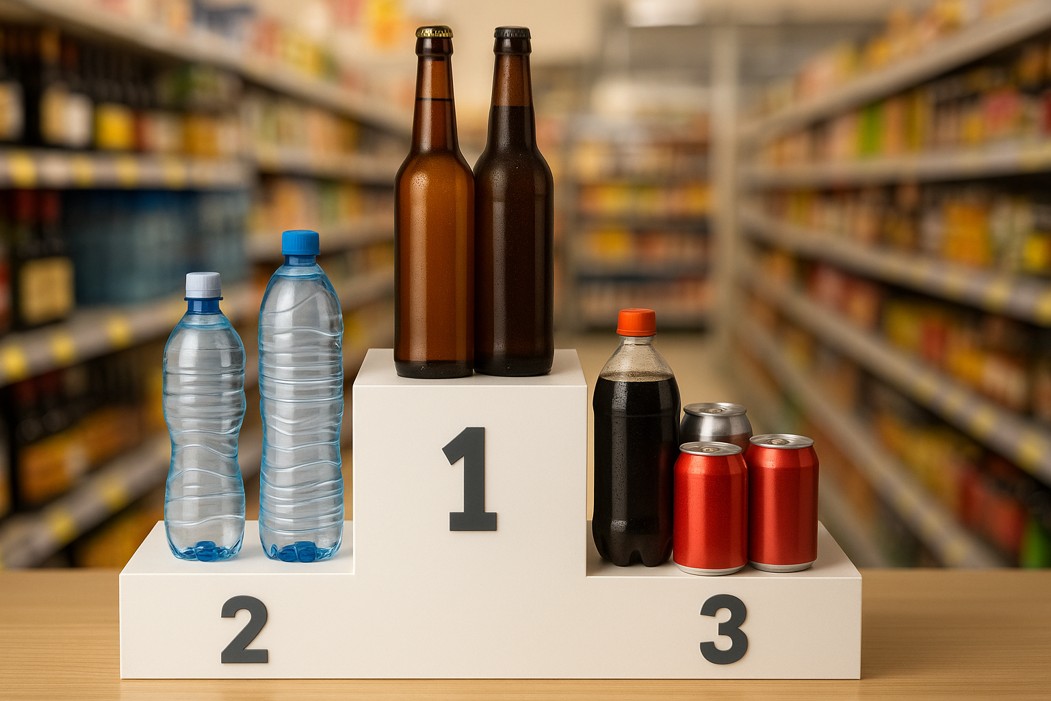
The European beverage market reached a total volume of around 323 billion units in 2024. The ten largest categories cover around 91 percent of the market. Despite clear leading markets such as Germany, the UK, and Russia, many categories have their own regional focuses. There are also significant differences in packaging systems. We present the top 10 categories with their respective special features and the most important market players.
One of the characteristics of the beverage market in Europe and the UK is that it is dominated in terms of volume by a few very stable segments. Across the entire market, growth over the last five years has been 0.9 percent CAGR. The dominant packaging systems are PET, glass, and cans.
10th place – Nectars
With 6.8 billion units, nectars make their entry into the top 10. The category has a long tradition in many countries. The most important containers are cardboard packaging and PET. Germany, Russia, and Italy are among the strongest markets. Brands such as Granini (Eckes), Cappy (Coca-Cola Company), and Yoga (Conserve Italia) dominate.
9th place – Iced and RTD tea
The market for ready-to-drink teas is growing moderately and is clearly aimed at younger and urban consumers. A volume of 7.1 billion units was achieved in 2024. PET bottles are the leading system, followed by cans, which dominate mainly in southern Europe. The strongest markets are Germany, France, and Spain. The most important brands include Fuze (Coca-Cola Company), Nestea (Nestlé), Pfanner, and Lipton (CVC Capital Partners/PepsiCo).
8th place – Juice drinks
With 8.3 billion units, juice drinks are just ahead of classic juices. The segment is broadly positioned and ranges from lighter fruit mix drinks to trendy lifestyle variants. PET bottles dominate the packaging market, supplemented by stand-up pouches and cartons. France, the UK, and Germany are the most important markets. The most important brands include Suntory, Robinsons (Carlsberg Britvic), Capri-Sonne (SiSi-Werke), and Oasis (Orangina Suntory / Coca-Cola Company).
7th place – Juice
The category reaches 8.5 billion units and has a comparatively stable consumption profile. PET and cardboard are the main packaging formats. The strongest sales countries are Germany, the UK, and France. Leading brands include Granini and Hohes C (Eckes), Valensina, Tropicana (Tropicana Brands Group / PepsiCo), and Innocent (Coca-Cola Company).
6th place – Hot coffee
With 9.6 billion units, this segment mainly comprises instant coffees, single servings, and capsule systems. Flexible packaging and aluminum pods are the dominant forms. The largest markets are Germany, France, and the UK. Key players and brands are JAB (Jacobs), Nestle (Nescafé, Nespresso), Lavazza, and Tchibo.
5th place – Energy drinks
This category has reached 14.4 billion units and has been one of the fastest-growing applications for years. Metal cans clearly dominate and shape the entire market landscape. Germany, the UK, and Russia are among the strongest markets. Red Bull, Coca-Cola Company (Monster), and Suntory (Lucozade) form the core trio of brand owners.
4th place – Wine
The still wine market also stands at 14.4 billion units, but despite its size, it remains highly fragmented. The glass bottle remains the undisputed leading packaging system. The market is characterized by a large number of regional producers, which is why no single markets or brands dominate. Instead, origin, tradition, and regional brand profiles determine demand.
3rd place – Soft drinks (carbonates)
With 60.4 billion units, this segment is one of the largest consumer pillars in Europe. The combination of PET and cans ensures a wide variety of packaging options. Germany, the UK, and Russia are the most important markets. The large global corporations dominate the segment with their brands, especially Coca-Cola Company, PepsiCo, and Suntory.
2nd place – Packaged water
This category reaches 74.6 billion units and is characterized by an almost complete PET monopoly in terms of packaging. The strongest markets are Germany, Italy, and Spain. Well-known brands include Gerolsteiner (Bitburger Holding), Evian and Volvic (Danone), S. Pellegrino and Perrier (Nestlé), Cristaline (Sources Alma), and Apollinaris (Coca-Cola Company).
1st place – Beer
With 88.7 billion units, beer remains by far the largest beverage category in Europe. Glass bottles and metal cans are the main packaging systems, with regions such as the UK and Eastern Europe being strongly can-oriented. Germany, the UK, and Russia are the largest sales markets. Although brand manufacturers such as Heineken, Carlsberg, and AB InBev dominate the field, only a few of their brands manage to achieve top rankings across Europe, as the market is strongly influenced by local and national preferences and accordingly produces many regionally anchored brands.
Conclusion
The top 10 categories clearly show how strongly the European beverage market is concentrated in a few segments. At the same time, individual applications have clear characteristics, whether in terms of the most important countries, the dominant packaging systems, or the brand structure. Across the market as a whole, growth of 0.9 percent CAGR over the last five years confirms the stable development of an otherwise very heterogeneous market.
