

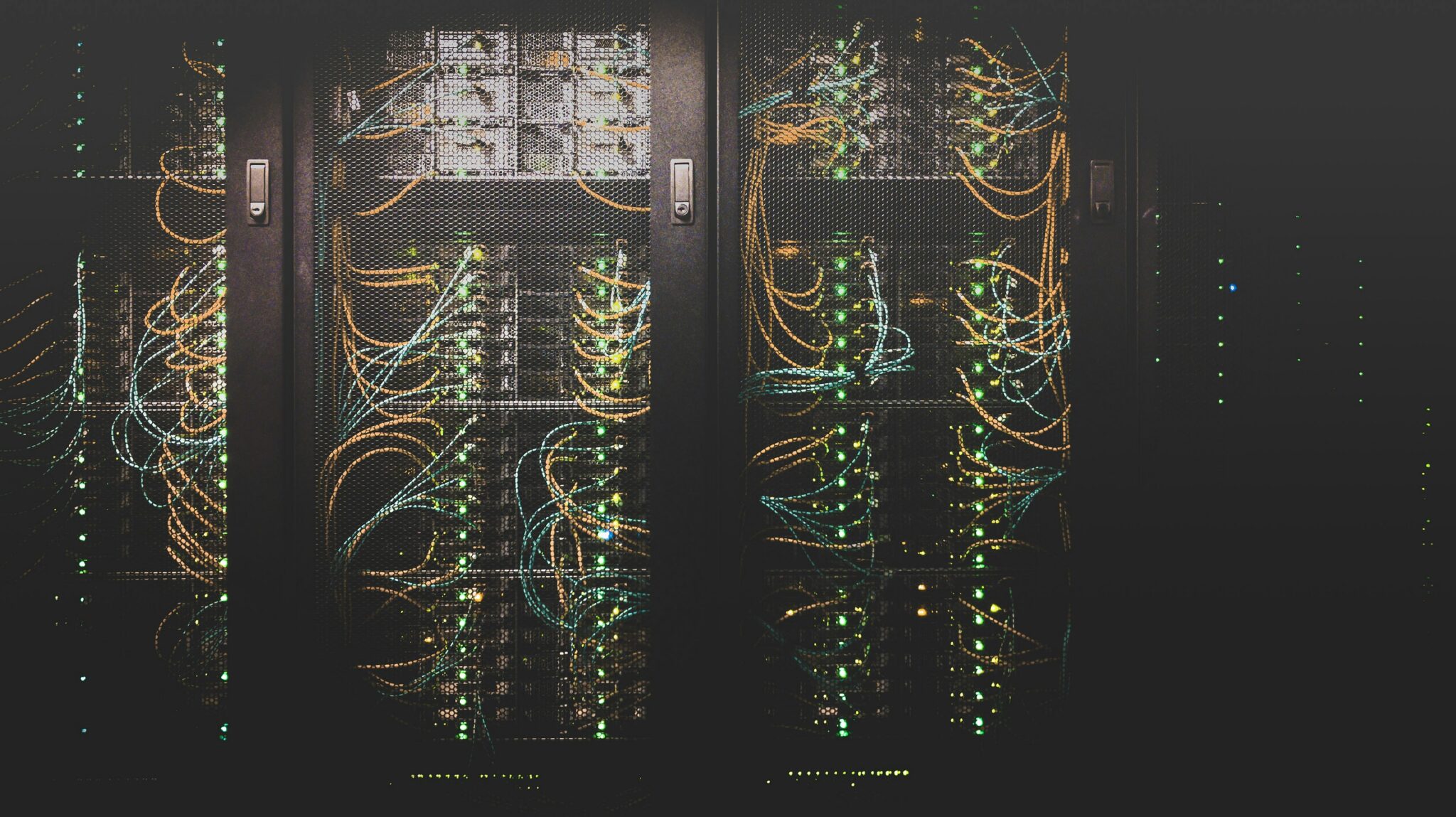
The United States is investing in artificial intelligence on a scale never before seen for a single industry. Around USD 10.3 trillion is set to flow into data centres and the related infrastructure by 2032, the Wall Street Journal reports. What sounds like a pure tech story is in fact a vast industrial project made of steel, copper, concrete and electrical equipment. And almost all of it has to be packaged, protected and transported. We show why packaging companies should take a closer look at this market now.
Bigger than the railway boom
According to estimates by economist Stijn Van Nieuwerburgh, published by the Brookings Institution, the AI build-out amounts to an average of 3.6% of US economic output per year. That is more than the construction of the railways in the 19th century, the highways or the fibre-optic networks (Wall Street Journal, 24 September 2026). And Europe is following suit: the European Commission aims to at least triple the EU’s data centre capacity within the next five to seven years.
Where the growth for B2B packaging lies
For the packaging industry, what counts is not the amount invested but what is physically moved. Chips and memory carry enormous value per kilogram but generate comparatively little demand for packaging. The big volume lever lies elsewhere: in transformers, switchgear and cables, in building materials and cooling systems, and in server racks that now weigh well over a tonne and travel fully integrated.
In our assessment, industrial and export packaging stands to benefit most. Power equipment has become the bottleneck of the build-out; according to Wood Mackenzie, lead times for large transformers now exceed three years. Goods like these travel in seaworthy crates with corrosion protection and professional load securing. Cables and optical fibre need drums and reusable systems in large numbers, and on the major construction sites demand is growing for films, pallets, sacks and strapping.
A second field is high-performance packaging for servers and racks. Here, it is not tonnage that counts but reliability, because any damage delays the commissioning of a data centre. What is needed are tested system solutions combining crate, cushioning, moisture protection and sensors, ideally in a reusable loop. On top of this comes industrial packaging for cooling fluids, since new AI racks are liquid-cooled, and cleanroom packaging for semiconductors as a demanding premium market.
And the demand does not arise just once. New chip generations follow in quick succession, hardware is replaced, and spare parts and returns generate recurring business. With the EU Packaging and Packaging Waste Regulation (PPWR), reusable solutions for transport packaging are gaining additional weight.
New customers, new rules
Anyone who wants to sell in this market will encounter a new buying centre: data centre operators, server integrators, manufacturers of power equipment and cables, general contractors. They think in commissioning dates, not unit prices. Speed, supply reliability, proven protective performance and engineering expertise beat a broad catalogue.
For suppliers from the DACH region, this is a real opportunity. Many manufacturers of power equipment and cables supplying the build-out in the US and Europe produce right on their doorstep. And in European campus projects, proximity becomes a competitive advantage over suppliers from overseas.
Part of the truth is that the build-out is a bet. A growing share of it is debt-financed, and not every announced project will be built. The AI build-out therefore justifies targeted investment in market access and expertise in a clearly defined focus segment, but not betting the whole company.
Identifying new markets early and developing them strategically
This is exactly where we come in. As a consulting partner to the packaging industry, we use our market intelligence to continuously track where new end markets are emerging, whether in the AI build-out, electromobility or the energy transition, and which of them fit your portfolio. An example from our practice shows how effective this can be: a transport packaging manufacturer that originally generated a large share of its revenue in a stagnating segment is now growing significantly in the future market of electromobility.
What makes the difference is rarely the idea alone, but the change it triggers within the company. New business follows a different logic from growing with existing clients. Three levers determine whether this transformation succeeds. Strategic focus sets the direction: which field of application truly deserves resources, and what do we want to stand for there? The operating model builds the engine: clear ownership of the target market, an industry manager with real capacity, and an offering and go-to-market processes that match the logic of the new customer. And execution power delivers the growth: market intelligence, audience-specific content, consistent outreach and steering that keeps the pace high. If one of these levers is missing, new business remains a flash in the pan. Ultimately, execution is what counts, very much in the spirit of Thomas Edison: genius is one percent inspiration and ninety-nine percent perspiration.
The bottom line
The AI build-out is one of the largest investment waves of our time, in the US and in Europe alike, and it is physical. For B2B packaging, the growth lies not in the billions spent on chips, but in the tonnes of power equipment, cables, building materials and racks that have to be protected and moved.
Those who approach this market with focus now can secure a place in one of the most dynamic supply chains of the coming years.
