

Is paper in flexible packaging still on trend or already over? This question lies at the heart of a widely debated transformation. Under the buzzword “paperisation”, it drives dynamics in our industry like few other topics. Matthias Giebel placed the topic at the centre of his presentation at the INNOFIBER conference by Innoform. His conclusion: the trend towards greater use of paper-based flexible packaging continues and is being supported both regulatorily and on the market side. But there are also limitations. In short: the competition between paper and plastic solutions has not yet been decided. However, a comprehensive expert survey points to an ongoing shift. Read more in our article.
The Trend and Its Starting Point
The industry’s voluntary self-commitments to plastic reduction and the circular use of plastics had proven insufficient in terms of the politically desired goals. It was political regulations that brought about the envisaged sustainability progress. The Circular Economy is understood here as the economic guiding model of the Green Deal and the Clean Industrial Deal.
The starting point for the trend known as “paperisation” is the European Packaging Regulation (PPWR). The PPWR aims to reduce packaging waste and greenhouse gas emissions while simultaneously accelerating innovation in recyclable packaging solutions. It defines recyclability, industrial recycling and the use of recyclates as core requirements.
Regulatory pressure is now affecting not only Europe, but is developing worldwide.
From Specific Materials to Results Orientation
The central question used to be “paper or plastic?”. However, the discussion is no longer about the struggle between two specific materials, but about who can fulfil the regulatory requirements and associated goals more quickly and efficiently.
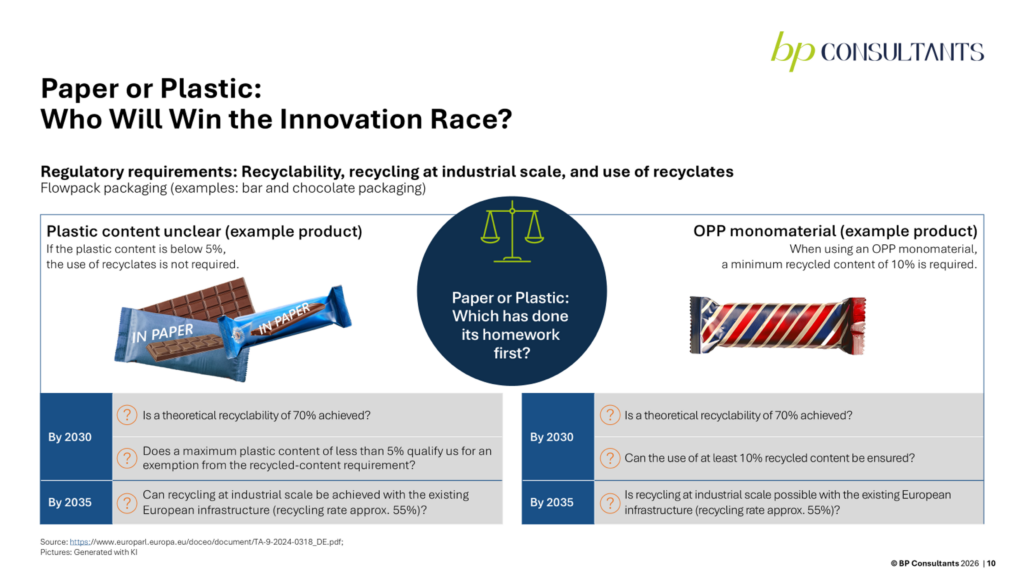
Image Source: BP Consultants “Paper or Plastic: Who will win the innovation race?”
This sets the stage for an innovation competition in which the paper side is currently particularly active.
Pros and Cons
- Plastics are extremely well-established in terms of barrier properties and functionality and have little to prove here.
- Their major disadvantage remains the absence of a closed loop. Plastics still struggle across Europe primarily with inconsistent infrastructure in this regard.
- Paper solutions have made significant advances in barrier properties and functionality in recent years. Several recent market examples show that paper-based solutions are now heat-sealable and can be equipped with oxygen and mineral oil barriers.
- At the same time, challenges remain regarding the actual recyclability of paper composites. They show that paper is not automatically a foregone conclusion.
Market Development
Not least due to the progress achieved in barrier properties and functionality, paper-based flexible packaging has now established itself in many consumer goods segments. It is particularly strongly represented in the confectionery, dry food and personal care segments.
Studies predict strong growth of paper-based composites in Europe by 2030, particularly through the substitution of conventional plastic packaging.
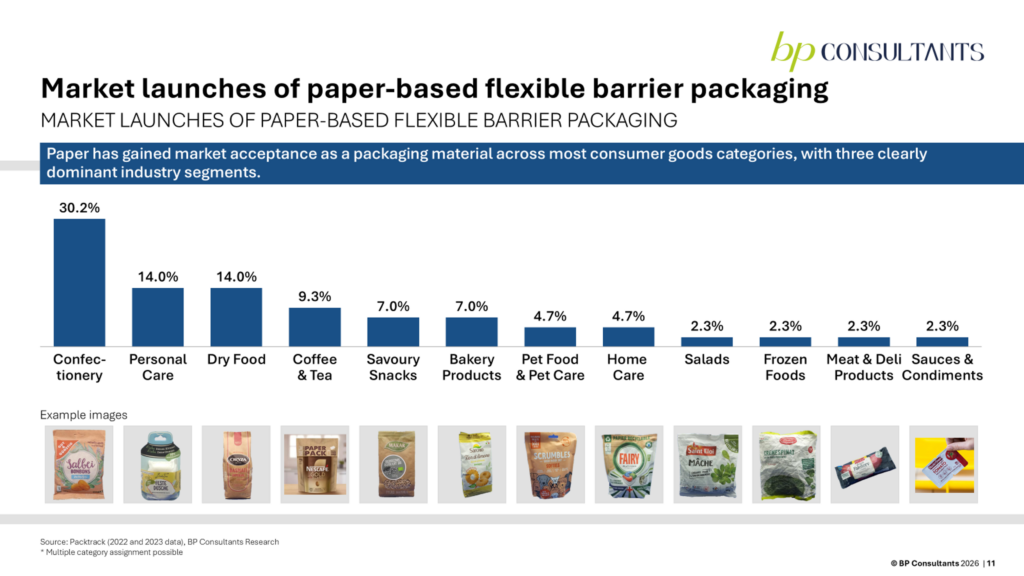
Image Source: BP Consultants “Market launches of paper-based flexible barrier packaging”
The Expert Survey Points the Way
An important factor in assessing the question of the future of paper-based flexible packaging is the opinion of those who will make the decisions.
As BP Consultants, we conducted a corresponding expert survey for Koehler Paper and spoke with branded goods manufacturers, converters and paper recyclers. With the kind permission of Koehler Papier, we can present some key findings here.
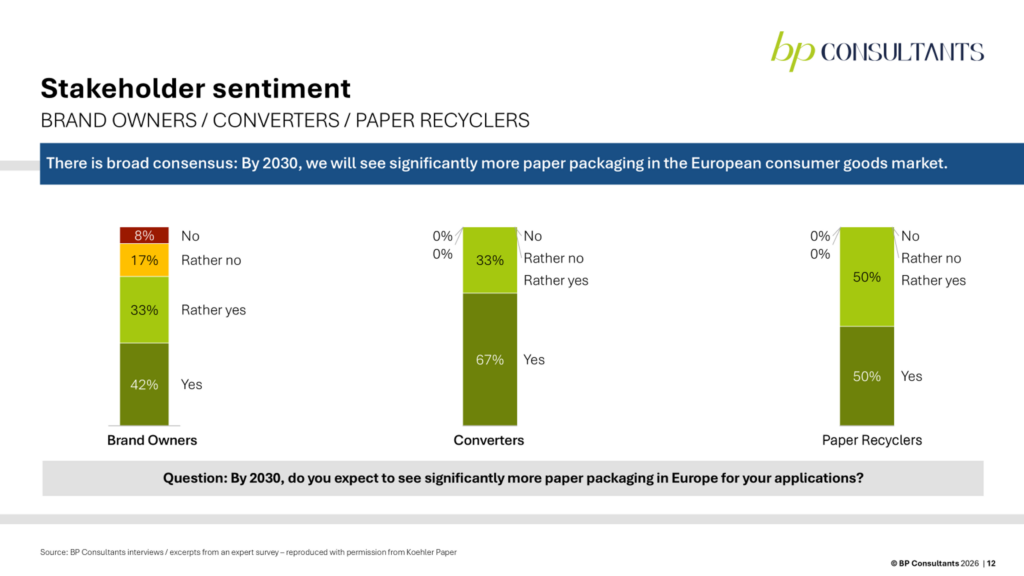
Image Source: BP Consultants “Stakeholder sentiment”
Notably: the survey shows a remarkably consistent picture: all target groups expect significantly more paper packaging in the European consumer goods market by 2030.
Conclusion
- The transformation is no longer just a vision, but day-to-day operational business. Fibre-based solutions are advancing at high speed – technologically, regulatorily and along the entire value chain. Paper in flexible packaging is clearly still on trend.
- At the same time, it is also clear: it is not just about material substitution. What is decisive is the interplay of functionality, scalability and economic viability.
- Paper benefits from regulatory developments, high consumer acceptance and technological advances, but still needs to achieve further improvements in recyclability and industrial circular economy management.
- This is precisely where it will be decided in the coming years which concepts will sustainably prevail. The competition between paper and plastic solutions has not yet been decided.
- However, the expert survey points, at least in Europe, to an ongoing shift towards paper-based packaging solutions.
For Further Reading
There is a short report and an interview with Matthias Giebel about the presentation on the INNOFORM websites.
