

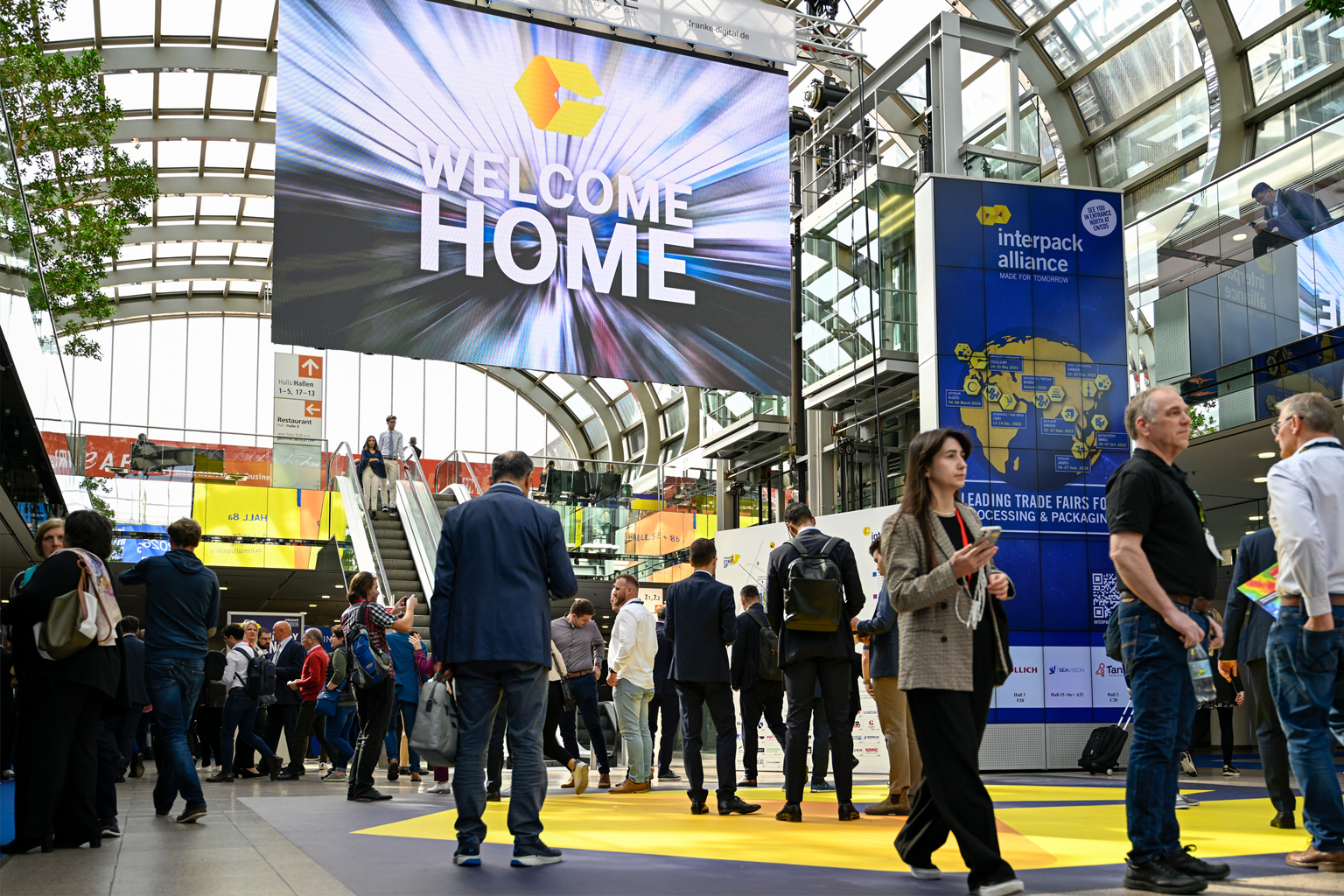
Was Interpack 2026 the hoped-for mood booster for the packaging industry? Opinions differ. On the one hand, it confirms its role as the international leading trade fair for processing and packaging and remains strong in terms of exhibitor numbers and breadth of topics. But there are also declining trends. We take a general look at the figures and the most important themes of the fair, look more closely at the machinery sector, and report on our joint project with Schubert and an example of the circular economy for polypropylene.
Interpack in Numbers
At Interpack, from 7 to 13 May 2026, a total of 2,804 exhibitors from 65 countries presented themselves. In addition, around 100 companies participated in the accompanying “Components” fair, which took place for the fourth time.
Overall, the fair reported around 127,000 trade visitors from 161 countries. Compared to Interpack 2023 with around 142,000 visitors, this represents a decline of approximately 15,000 people, or around 10.6 percent.
Notably, the picture for exhibitors is different. Here, Interpack was able to increase from 2,728 exhibitors in 2023 by 2.8 percent, or 76 exhibitors, to 2,804.
The Perceived Reality
Subjectively, during our multi-day fair visit we also had the impression that there were fewer visitors in the halls than usual. On the other hand, during stand visits and personal conversations, particularly with the machinery manufacturers present, we experienced the opposite. Here we encountered very well-attended stands, high-quality conversations at decision-maker level and satisfied faces.
Visitor Structure Changing? Europe, USA, Asia
What we heard more frequently was the impression that there were fewer visitors from the USA and Asia than before. The figures actually confirm that while the visitor structure remains international overall, it has shifted.
- In 2026, 75 percent of visitors came from abroad, of which 28 percent were from overseas. In absolute terms, at 127,000 visitors, this corresponds to approximately 35,600 overseas visitors.
- In 2023, two thirds of visitors came from abroad. The Interpack structural data for 2023 indicate, by origin, 70 percent Europe, 16 percent Asia, 9 percent America and 4 percent Africa. This gives a non-European share for 2023 of approximately 30 percent, i.e. around 42,600 people.
- Overall, this suggests that the absolute number of non-European visitors in 2026 was more than 15% lower than in 2023.
The perceived decline for the USA and Asia is therefore plausible, even if not confirmed in detail.
Exhibitor Mix Changing?
The proportion of converters and packaging manufacturers among exhibitors has also perceptibly decreased. This cannot be read from the statistics, but it is noticeable when there is no exhibition stand from Amcor, Constantia Flexibles or Mondi on site.
The available official Interpack figures do not answer the question of what the situation looks like specifically for packaging manufacturers. For 2026, the fair puts the number of exhibitors in the “Packaging Materials, Packaging and Packaging Aids” category at 1,016. However, a directly comparable figure for 2023 is lacking.
The Main Themes at Interpack
Manufacturing, Innovative Materials and Future Skills were the three main themes of this year’s Interpack.
- The official fair communications cited as concrete topics: automation, digital and data-based production systems, AI applications, flexible plant concepts, and new materials in terms of recyclability, resource efficiency and regulatory requirements such as the PPWR.
- Based on our own experience, we can confirm that automation and, in particular, flexible plant concepts were top themes. Modular, future-proof machine concepts impressed visitors at many stands.
- Surprisingly, the PPWR was a topic at comparatively few stands. At Fachpack last year, this had looked quite different.
Schubert and BP Consultants at Interpack
However, together with Schubert as a pioneer in the development of modular packaging machinery, BP Consultants was able to set an important marker with regard to the PPWR. Specifically, the aim was to support manufacturers of fast-moving consumer goods (FMCG) as well as industrial product manufacturers as partners – from identifying the need for change required by legal regulations to automating packaging lines.
To this end, at Schubert’s stand and within the framework of our joint PackagingCompetenceCenter, we demonstrated the influence of the PPWR and the need for change in packaging and packaging materials triggered by the new EU regulation, and how this affects the automation of packaging lines – including case studies on typical consumer packaging that may not meet the requirements of the PPWR and where adjustments are required.
Circular Economy for Polypropylene Packaging
Jokey Group and Remondis demonstrated how the circular economy can be advanced with a project being driven forward with the support of the WWF. Specifically, the project concerns a closed material cycle for polypropylene packaging from the food industry. The aim is to collect used plastic packaging from the commercial food sector, process it and reuse the recyclate obtained from it for food-contact packaging.
In a panel session, representatives of the three project partners presented their work and emphasised the importance of strong partnerships for a successful “packaging transition”. WWF representative Tom Ohlendorf made clear that the industry had achieved a lot in recent years but that much remained to be done. In his own words: “We continue to see many unnecessary and non-optimised packaging solutions, too high use of primary materials, too few optimised reuse systems, high volumes of waste and environmental pollution.”
Conclusion
Overall, Interpack 2026 presents an ambivalent picture: the fair remains strong in terms of internationality, number of exhibitors and breadth of topics, but at the same time recorded a clear decline in visitors compared to 2023. The future will show whether the declining trend in non-European visitors is a critical turning point and needs to be interpreted as a further sign of declining globalisation.
In our conversations with machinery manufacturers, we were able to establish that a stronger focus on Europe is already being pursued as a valid strategic option.
